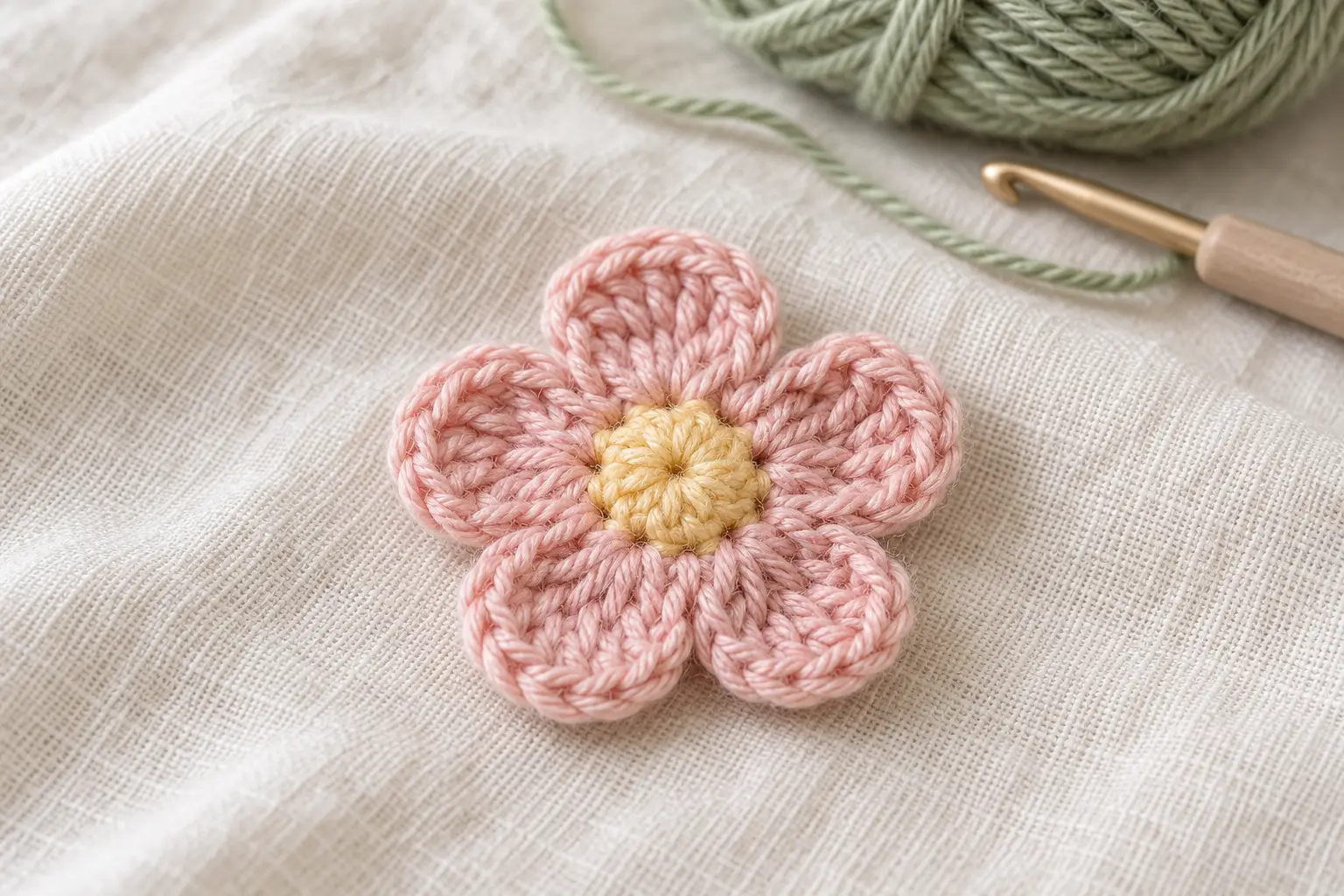
An easy crochet flower pattern is a satisfying place to start: one small project, a clear shape, and a finished bloom you can use on a gift. Begin with a single flower rather than a whole bouquet, and give yourself time to learn how the center and petals fit together.
For the project in this guide, follow Sarah Stearns’ free five-petal flower pattern at Sarah Maker. Her page contains the full stitch instructions and process photographs. This companion guide helps you prepare, read the pattern, and decide how to use your flower.
Pattern credit: Sarah Stearns, Sarah Maker. My Flower Bouquets has reviewed the published instructions but has not independently crocheted or tested this design.
Images are AI-generated illustrations for inspiration, not photographs of a tested project. They do not show the exact stitch construction of the linked designer’s pattern.
Choose an Easy Crochet Flower Pattern You Can Follow
A useful first project gives you something specific to check at each stage. Before starting any basic crochet flower pattern, look for a clear stitch key, a photograph of the finished flower, instructions for joining rounds, and an explanation of any special stitch. “Easy” does not mean that every technique will already be familiar.
The design uses a magic ring and treble clusters. Review the cluster explanation before starting.
Open the full free pattern and step photos at Sarah Maker. Keep that page beside your work so the designer’s instructions remain your reference.
Gather Your Yarn and Tools
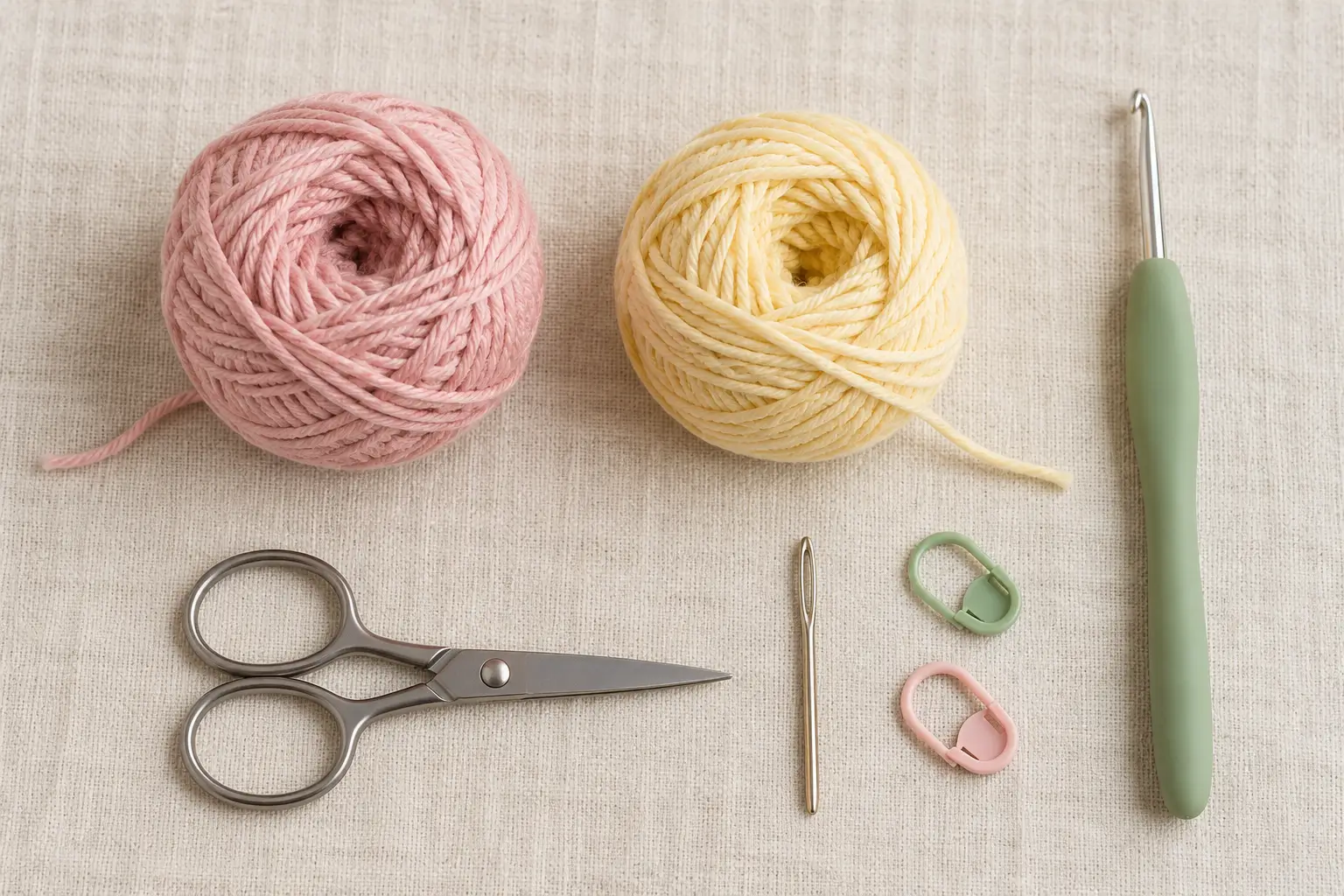
The detailed pattern specifies worsted cotton and a 4 mm hook, although its introduction mentions 5 mm. Start with the detailed specification and check for updates. Have scissors and a yarn needle ready.
Choose colors you can comfortably distinguish while counting. For your first sample, keep the same yarn type for the center and petals. Make a note of the yarn label and hook size so you can repeat the combination if you like the result.
Yarn weight describes a thickness category, not the weight of the ball. Worsted yarn belongs to the Craft Yarn Council’s medium category, commonly labeled number 4. Its yarn-weight chart provides general hook guidelines; an individual pattern may specify a different size for its intended fabric.
Avoid buying supplies for an entire bouquet before making one sample. The first flower is your chance to decide whether you enjoy the technique and whether its size and texture suit the gift you have in mind.
Understand the Crochet Terms Before You Start
Keep the pattern’s stitch key within reach. In US terminology, ch means chain, sc means single crochet, sl st means slip stitch, and tr means treble crochet. A special cluster abbreviation needs the designer’s own explanation.
US and UK stitch names differ. A US single crochet is a UK double crochet, while a US treble is a UK double treble. Mixing the systems changes the stitch you make. Check the Craft Yarn Council’s abbreviation and conversion guide if your usual tutorials use UK terms.
Before working a round, identify its beginning, the repeated section, and where it finishes. Highlight those parts on your own notes. If the instructions tell you to repeat a sequence, track completed repeats rather than relying on how many petals seem to be visible.
Follow the Flower Pattern Without Losing Your Place
1. Read the whole project first
Locate the designer’s foundation, petal instructions, special-stitch explanation, and finishing section. Read them once before picking up the hook. Keep the original wording available instead of reconstructing the sequence from a photograph.
2. Pause after the center
Check your work against the designer’s stated count before moving on. Pay particular attention to whether an opening chain counts as a stitch: that detail belongs to the specific pattern, not to a universal crochet rule. If the count differs, resolve it while the center is still easy to inspect.
3. Complete one petal deliberately
Work through the original petal instructions slowly, then compare your first petal with the source photograph. Identify the attachment point before beginning another repeat. A written tick beside each completed repeat can be easier to follow than repeatedly recounting a partly finished flower.
4. Check the finished flower before making more
Compare the finished petal count with the pattern, inspect the joins, and follow its finishing instructions. Photograph your sample next to a ruler and record its dimensions. That gives you a useful reference for the next flower without assuming that your tension matches the designer’s.
What to Check If Your Flower Looks Different
The petals do not look alike
Compare two neighboring repeats with the original instructions. Check that you used the same stitch sequence and worked into the intended place each time. Correct the first mismatch you can identify rather than changing the remaining petals to compensate.
You cannot tell where a round begins
Stop before adding more stitches. Review the source’s joining instructions and locate the beginning again. Once identified, a removable marker can help you keep track during the next check.
The flower is a different size
First compare your yarn category and hook with the specified materials. Your own tension also affects the result. A size difference is not, by itself, proof that the stitch sequence is wrong. Record the result and decide whether that size works for your intended use.
You keep restarting
Separate the unfamiliar skill from the project. Practice the difficult stitch with spare yarn, then return to the flower. It is reasonable for a first attempt to become a learning sample rather than the flower you give away.
Give Your First Bloom a Purpose
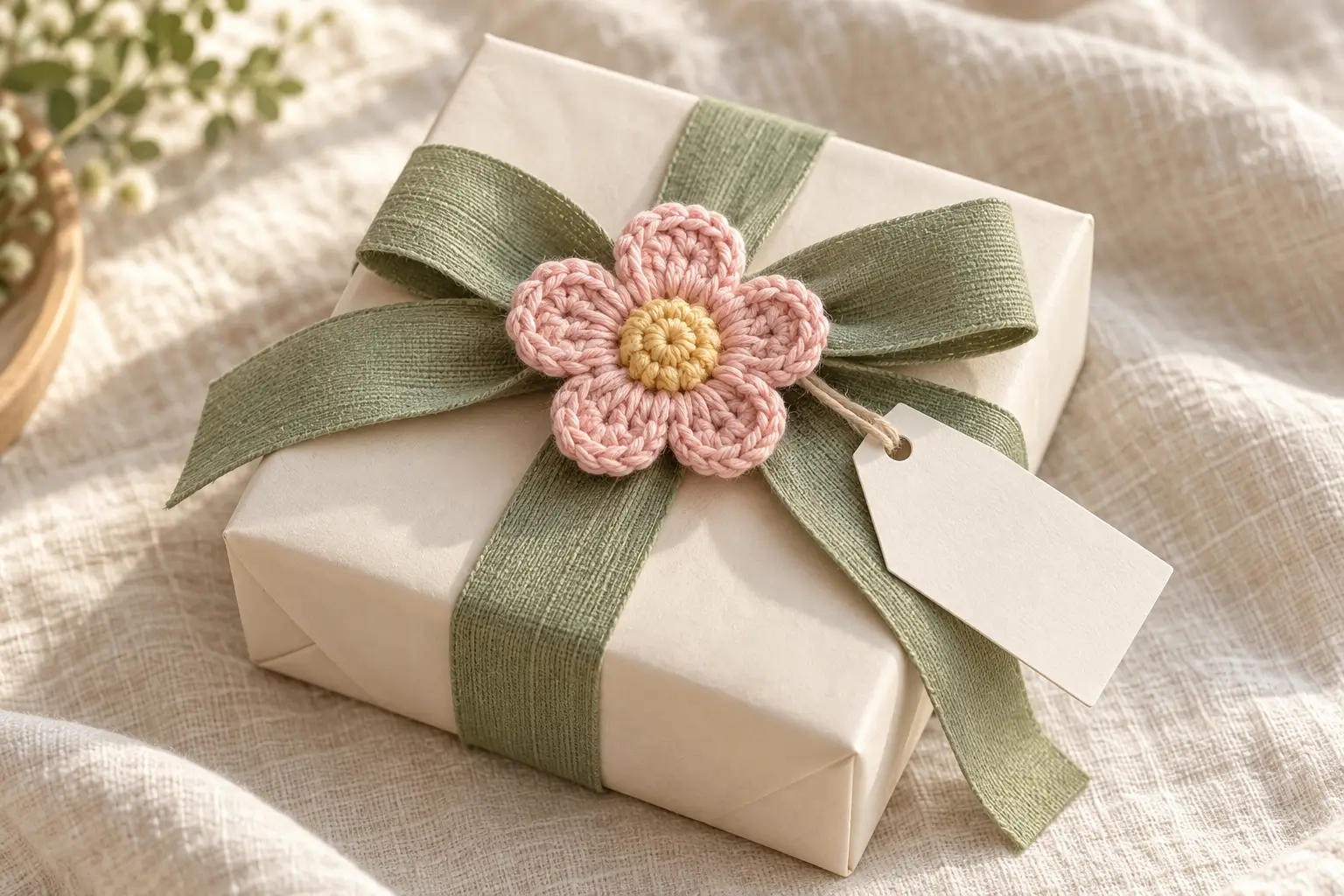
Crochet Flower Applique Pattern: Use a Flat Bloom as an Embellishment
A crochet flower applique pattern is designed to make a mostly flat flower that can be attached to another item, rather than a dimensional bloom built around a stem. This five-petal flower can work as a visual starting point for a small embellishment, but check its finished shape and thickness before choosing where to use it.
For a dedicated flower-and-leaf applique with its own written instructions, see Crafting Happiness’ free crochet flower and leaf applique pattern. It is presented for flat decorations such as hats, scarves, headbands, bags, and jackets. Follow that designer’s pattern on the original page; this guide does not reproduce it.
To attach a finished motif, pin it in place first, then sew it securely with a yarn needle and matching yarn, catching the base stitches without pulling the fabric out of shape. Test the attachment on a scrap or inconspicuous area, especially on stretchy or frequently washed items. Here are three other styling ideas to consider once your sample is finished:
A gift-tag accent: choose a petal color that picks up one color in the wrapping paper. Try the placement before deciding how to attach it, and keep the recipient’s name readable.
A bouquet-ribbon detail: place the flower visually against a finished ribbon bow to judge the proportions. Our bouquet ribbon guide offers bow ideas; adding a crochet accent is a separate styling choice, not a stem-attachment method.
A coordinated gift set: repeat your chosen yarn colors across several flowers once you can reproduce the first one consistently. Matching the colors can make individually wrapped gifts feel connected without requiring every flower to be identical.
A flat flower motif is not automatically a freestanding bouquet flower. A stemmed arrangement needs an attachment method suited to its structure. Treat that as a separate project rather than assuming the flower pattern also teaches stem construction.
Easy Crochet Flower Pattern FAQs
Can a complete beginner make this flower?
The designer labels it easy. Practice unfamiliar stitches first; a difficulty label does not measure your personal experience.
Do all crochet flowers need a magic ring?
No. For example, Crochet Guru’s Any Day Flower uses a joined-chain foundation and provides right- and left-handed video links. Follow that complete design if you choose it; do not swap foundations between patterns without checking the instructions.
How long will my first flower take?
Allow yourself a practice session rather than a deadline. Reading abbreviations, checking repeats, and restarting an unfamiliar stitch are part of learning. A designer’s making time does not tell you how long your first attempt should take.
Is there a free PDF with this guide?
This guide does not include a downloadable pattern. The linked designer’s page provides the written instructions online. Keep the distinction in mind when saving resources: a free webpage is not necessarily a free PDF.
Should I make a whole bouquet next?
Start by checking whether you can repeat the same flower with a reasonably consistent result. Then choose a dedicated bouquet design that explains stems and assembly. You can return to our Crochet Flower Patterns category as new projects are added.