
Fuzzy wire flower tutorial: Learn how to make a beautiful fuzzy wire flower from soft chenille stems (also called pipe cleaners) with simple petal loops, a secure flower center, a reinforced stem, and handmade leaves. This beginner-friendly pipe cleaner flower tutorial walks you through the materials and easy steps for creating colorful blooms for bouquets, gifts, or home decor.
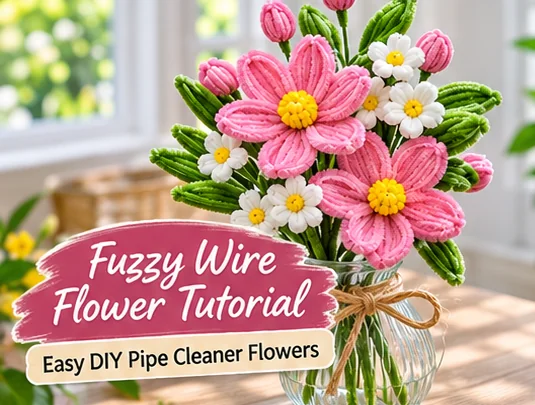
Quick answer: To make a simple fuzzy wire flower, shape several chenille stems into matching petal loops, twist their ends together around a small center, add a reinforced stem and green leaves, then gently adjust the petals until the flower looks balanced.
What Are Fuzzy Wire Flowers?
Fuzzy wire flowers are craft flowers made by bending chenille stems a flexible wire core covered in soft fibers into petal and leaf shapes. “Fuzzy wire,” “chenille stems,” and “pipe cleaners” are commonly used names for this craft material. The wire core holds the shape, so you can curve petals and leaves without sewing. Learn more about chenille fiber and its soft, textured finish.
Materials You Need
Disclosure: This article contains affiliate links. If you purchase through these links, we may earn a commission at no extra cost to you.
- Colored chenille stems / pipe cleaners in bulk for petals
- Assorted-color chenille stems for mixed flower designs
- 22-gauge green floral wire to reinforce stems
- Green floral tape to wrap stems and joints
- Flower stamens, or pearl craft beads, for the flower center
- Mini craft wire cutters for cutting craft wire safely
- Optional: pipe cleaner flower craft kit or flower-making supplies if you prefer a ready-made assortment
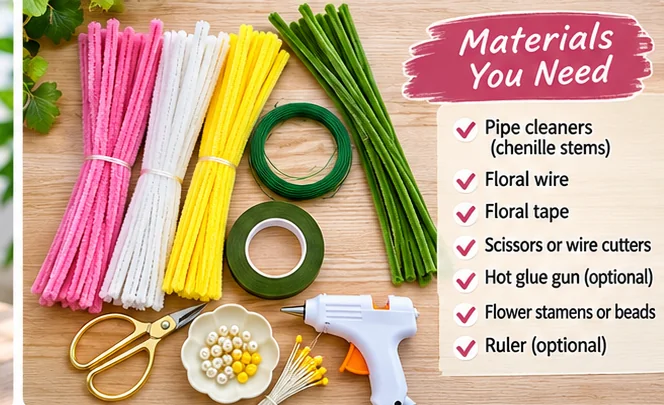
Choose stems with a consistent thickness and a soft covering that does not shed excessively. For a first project, avoid very thin wire or complicated layered designs.
My Recommended Tools for Making Pipe Cleaner Flowers
If you’re making pipe cleaner flowers for the first time, start with colorful chenille stems and a few basic floral tools. You don’t need a large craft collection to create beautiful blooms.
- Best for beginners: A pipe cleaner flower kit with assorted colors.
- Best for sturdy stems: Green floral wire and floral tape.
- Best for beautiful flower centers: Craft stamens or pearl beads.
Choose the supplies that match your flower design, and keep your first project simple.
Fuzzy Wire Flower Tutorial: Step-by-Step Instructions
1. Choose a simple flower shape and colors
Start with a five- or six-petal flower. Choose one main color for the petals, a contrasting color for the center if desired, and green stems for the leaves. A simple shape is easier to keep symmetrical while learning.
2. Form matching petal loops
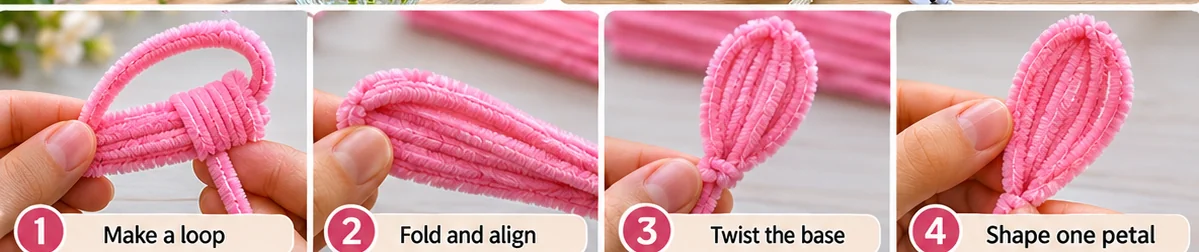
Fold one chenille stem into a rounded loop, leaving a short tail at the base. Pinch and twist the tail so the loop holds its shape. Repeat to make several petals of similar size. Keep the loops slightly elongated if you want an oval petal, or rounder for a daisy-like bloom. Compare the petals as you make them so they are similar.
3. Gather the petals around the center
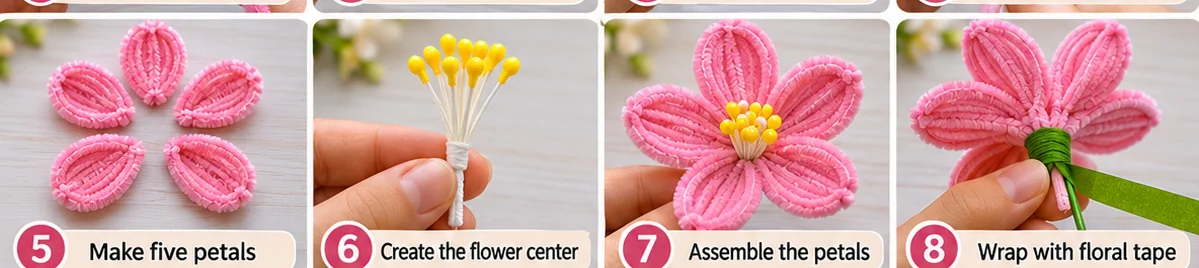
Bring the twisted ends of the petals together. Arrange them evenly around a small center, overlapping their bases slightly. Twist the wire ends together firmly but not so tightly that the petals buckle. Rotate the flower as you work to check that the petals are evenly spaced.
4. Add and secure the flower center
Use a small wrapped chenille-stem knot, a craft stamen bundle, or a pearl bead attached securely to create the center. If using glue, keep it away from fingers and allow it to cool or cure fully before shaping the flower. The center should hide the gathered petal bases without overpowering the bloom.
5. Reinforce the stem
Twist the gathered flower base around green 22-gauge floral wire or a sturdy craft stem. If the chenille stem alone feels floppy, use a thicker wire core and wrap the joint with floral tape. Test the stem gently before adding leaves. Never force wire through the flower in a way that could expose a sharp end.
6. Shape the leaves
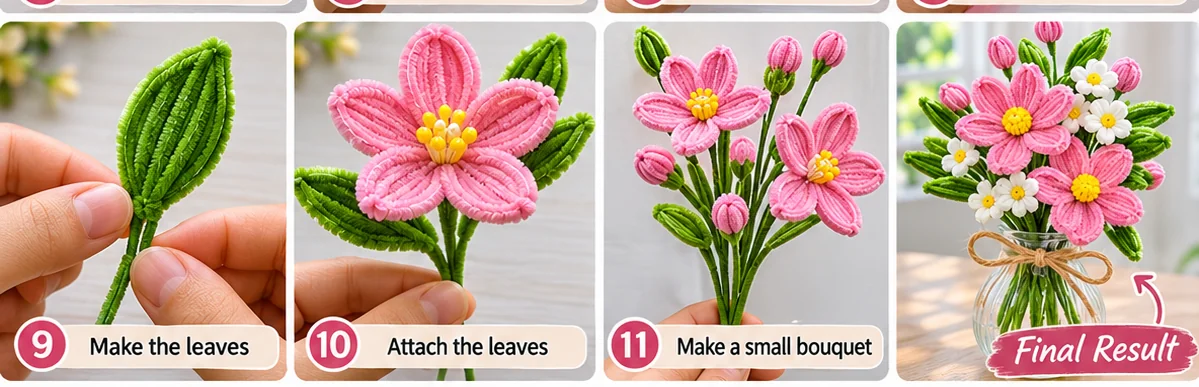
Fold a green chenille stem into one or two leaf loops. Pinch the pointed ends and twist the base to create a leaf shape. Attach the leaf base to the stem and wrap it neatly. Bend the leaf gently into a natural curve, keeping the wire end tucked away.
7. Finish and adjust the petals
Fluff the fibers, gently curve each petal, and make small adjustments to spacing. If one petal is larger, reshape the loop rather than pulling aggressively. Turn the flower toward the light and view it from the front and side before calling it finished.
How to Make the Flower Look More Realistic
- Vary the petal curve: gently cup some petals and leave others flatter rather than making every petal rigidly identical.
- Use a restrained color palette: two petal shades plus green often look more cohesive than many unrelated colors.
- Hide joins: position the center and calyx so they cover gathered wire ends.
- Shape from multiple angles: inspect the flower head from the front, side, and above.
- Add leaves sparingly: a few well-shaped leaves can make the stem look finished without crowding the flower.
How to Make a Strong Pipe Cleaner Flower Stem
In this fuzzy wire flower tutorial, flower heads can become heavy when many chenille stems are layered. For a stronger stem, use florist wire or a sturdy craft wire as the structural core, twist the flower base around it, and wrap the connection with floral tape. Keep the wire tip covered and avoid leaving exposed sharp ends. For a bouquet, use stems that bend easily for arranging but support the flower head when placed in a vase.
Common Problems and How to Fix Them
Petals look uneven
Compare loop sizes before gathering them. Reshape the largest and smallest petals by pinching their bases and adjusting the curves. Make small corrections rather than pulling the whole flower apart.
The flower looks flat
Curve the petals slightly forward or backward and raise the center. A few petals with different angles create depth. Avoid compressing the flower head during assembly.
The stem bends under the flower
Reinforce it with florist wire or a sturdier craft stem, then secure the joint and wrap it. A large layered bloom usually needs more support than a small flower.
The flower center looks messy
Gather petal bases into a tighter, more even bundle and cover the join with a center piece or green calyx. Trim loose ends only when they can be cut safely and do not compromise the wire structure.
Petals loosen after assembly
Twist the bases firmly, use a suitable reinforcement at the joint, and check that the center covers the connection. If using adhesive, choose one suitable for the materials and follow its safety instructions.
How to Make a Fuzzy Wire Flower Bouquet
Make several flowers using a coordinated palette, then arrange them at different heights. Place larger blooms near the center or slightly above the smaller flowers, add a few leaves between heads, and gather the stems gradually rather than forcing them into a tight bundle. Trim or adjust the stems to balance the bouquet, wrap them with floral tape or ribbon, and place the finished arrangement in a vase.
For more inspiration, see our pipe cleaner flower bouquet ideas and DIY guide, which can help you plan a fuller arrangement.
Frequently Asked Questions
How do you make flowers with fuzzy wire?
Shape chenille stems into matching petal loops, twist the petal bases together around a center, reinforce the stem, and add leaves. Adjust the petals gently to finish the flower.
What materials do you need to make pipe cleaner flowers?
You’ll generally need colored pipe cleaners, green stems for leaves, a craft or florist wire stem, scissors or wire cutters, and optional floral tape, stamens, beads, or glue.
How many pipe cleaners do you need for one flower?
It depends on the flower design and stem thickness. A simple loop-petal flower may use several stems for its petals plus separate material for the center, stem, and leaves. Plan the design first and make matching petals before assembling.
Are fuzzy wire flowers easy for beginners?
Yes. Rounded loop petals are a beginner-friendly design because the wire holds its shape and the petals can be reshaped. Start with a small flower and add layers after you are comfortable twisting and securing the bases.
How do you make pipe cleaner flower stems stronger?
Use florist wire or a sturdy craft wire as the core, secure the flower base around it, and wrap the connection with floral tape. Cover any sharp wire ends.
How do you keep pipe cleaner flowers from falling apart?
Twist the petal bases securely, keep the gathered joint compact, and reinforce the connection between flower head and stem. If using glue, follow its instructions and allow it to set fully before handling.
Final Tips
Take your time matching the petal loops, securing the flower center, and reinforcing the stem. A simple fuzzy wire flower can be reshaped after assembly, so small imperfections are easy to correct. Once you have made one bloom, try different petal shapes and colors or combine several flowers into a handmade bouquet.